

Welcome to issue 4 of Stablecoin State.
The weekly stablecoin brief for finance leaders, builders and fintech professionals who understand that stablecoins are a monetary infrastructure story - not a crypto story.
Last week we covered the ‘Tehran Toll’ - Iran's attempt to charge passage through the Strait of Hormuz in yuan and stablecoins : ‘The hard part about playing chicken’ through the lens of the 90s classic, The Hunt for Red October.
This week, someone blinked.
(Sort of.)
The US Navy is now blockading Iranian ports.
Peace talks in Pakistan collapsed.
230 loaded tankers are sitting inside the Gulf with nowhere to go.
Brent crude is within touching distance of $100.
And four days before the blockade was announced, Treasury quietly dropped the first enforcement rules under the GENIUS Act - closing the stablecoin corridor Iran was using to route around SWIFT and OFAC
A naval blockade and a financial blockade.
Running in parallel.
This was never a crypto story.
It is a story about who controls the rails of global money flows - and what happens when a nation state decides to test them.
Issue 4 unpacks the game theory, the NIM implications for your balance sheet, and why the only winning move may have been not to play.
THIS WEEK
The GENIUS Act grows teeth
The Yield War
The Strait of Hormuz - as it stands
Main story: The only winning move
NEWS
THE GENIUS ACT GROWS TEETH

On April 8, Treasury's FinCEN and OFAC dropped a joint proposed rule implementing the GENIUS Act's AML and sanctions compliance requirements.
This is the first concrete enforcement step since the Act was signed into law in July 2025.
The headline for global treasury teams: permitted payment stablecoin issuers are now treated as financial institutions under the Bank Secrecy Act.
Full AML and CFT programs.
Suspicious activity reporting.
Customer due diligence.
Sanctions screening - including the technical capability to block or freeze transactions on-chain.
That last sentence matters. This is not a compliance form.
It is a kill switch
Full enforcement begins January 18, 2027. The public comment period runs to June 9.
Why this matters
For years, stablecoins operated in a grey area.
Useful. Fast. Largely ungoverned.
That era is ending.
The GENIUS Act doesn't just regulate stablecoins -- it conscripts them into the existing sanctions architecture.
OFAC lists. BSA obligations. Freeze and burn capabilities baked into the issuer's technical infrastructure.
If you run a treasury, a payments desk, or a correspondent banking relationship, this is the moment the compliance perimeter expanded.
Stablecoins are no longer outside the fence.
THE YIELD WAR

The White House and the American Bankers Association are in open conflict over stablecoin yield -- and the fight landed in public this week.
On April 8, the White House Council of Economic Advisers released a 20-page report concluding that yield-bearing stablecoins pose little threat to bank deposits or lending.
The finding directly supports the crypto industry's position in ongoing negotiations over the Clarity Act.
Their economists said the White House had "studied the wrong question." The real risk isn't what happens if you ban stablecoin yield. It's what happens if you allow it.
They have a point worth taking seriously.
Coinbase currently offers around 3.5% rewards on USDC balances. Chase's standard savings account pays 0.01%.
That yield gap doesn't need to capture the whole market to cause damage.
It just needs to capture enough of the right depositors -- the rate-sensitive ones -- to move the needle on funding costs.
Standard Chartered put a number on it.
They project $500 billion will exit developed market banks by end of 2028 as stablecoins scale toward a $2 trillion market cap. Bank of America CEO Brian Moynihan went further in January -- warning that up to $6 trillion in deposits could shift to stablecoins if yield is permitted.
The legislative standoff continues. The Clarity Act remains stalled in the Senate.
Why this matters
I spent years on ALM desks watching funding cost assumptions get stress-tested as the net interest margin (NIM) was modelled.
The scenario that kept treasurers up at night was never a sudden shock -- it was a slow, structural migration of rate-sensitive deposits toward higher-yielding alternatives.
Structural NIM compression.
Banks saw it with money market funds in the 1980s. Depositors didn't panic. They just did the maths.
Stablecoins offering 3.5% against a savings rate of 0.01% is not a crypto story.
It is a deposit pricing story.
And if the Clarity Act passes without closing the yield loophole, every retail bank treasury in the developed world will need to revisit its funding cost assumptions.
The $500 billion number from Standard Chartered is the floor.
Moynihan's $6 trillion is the ceiling.
Your actual exposure sits somewhere in between -- and it depends almost entirely on how quickly your depositor base does the maths.
THE STRAIT OF HORMUZ - THE BOARD AS IT STANDS

This one is moving fast, so here are the facts as of Wednesday, April 15.
Iran has blockaded the Strait of Hormuz since February 28, following the US and Israeli air campaign that killed Supreme Leader Khamenei.
The IRGC has conducted 21 confirmed attacks on merchant vessels, laid sea mines throughout the strait, and was charging tolls - payable in yuan or stablecoins - on ships seeking passage.
USDT (Tether) was the preferred stablecoin, on the Tron blockchain.
Maersk, CMA CGM, and Hapag-Lloyd suspended all transits.
Roughly 20% of the world's seaborne oil and LNG normally passes through the strait.
Brent crude has risen approximately 40% since the conflict began and remains elevated, at around $100 a barrel.
On Sunday April 13, after peace talks in Pakistan collapsed, President Trump announced a US naval blockade of all Iranian ports. Effective 10am ET Monday.
CENTCOM clarified the blockade applies to vessels entering or departing Iranian ports and coastal areas -- not to ships transiting to non-Iranian ports.
Mine-clearing operations are underway.
A 40-nation coalition led by the UK is forming to restore freedom of navigation. The Indian Navy has deployed five warships to escort Indian-flagged vessels in the Gulf of Oman.
As of today, 230 loaded oil tankers remain inside the Gulf with nowhere to go.
Iran has vowed to retaliate.
Trump has not ruled out resuming strikes.
The only thing both sides agree on: this is not over.
Why this matters
Twenty percent of the world's seaborne oil doesn't move through the Strait of Hormuz by accident.
It moves there because for decades it was the cheapest, most reliable route from the Gulf to the rest of the world.
That assumption is now suspended indefinitely.
For treasury and finance leaders, the immediate implications are threefold.
Firstly, oil price volatility at this magnitude feeds directly into inflation expectations, which feeds into rate assumptions, which feeds cost of capital projections.
If you haven't stress-tested your energy cost assumptions against a sustained $100-plus oil environment, now is the time.
Second, the correspondent banking corridors that run through Gulf financial centres -- Dubai, Abu Dhabi, Bahrain -- are under pressure in ways that don't show up in oil price charts.
Watch for signs of stress in UAE dirham liquidity and Gulf interbank rates over the coming weeks.
Third - and this is the thread we pull on in this week's feature - the stablecoin corridor Iran was using to route around SWIFT and OFAC has now been directly targeted by the GENIUS Act enforcement rules.
Two blockades. One strait.
The game theory gets interesting from here.
MAIN STORY
THE ONLY WINNING MOVE

Matthew Broderick and early-1980s A.I.
In 1983, a Pentagon supercomputer ran every nuclear war scenario it could find.
Three million simulations.
Every permutation of first strike, counter-strike, escalation, and retaliation. The computer - WOPR, the War Operation Plan Response - ran them all.
Every single one ended the same way.
So it stopped.
"A strange game. The only winning move is not to play."
Watching as a kid, I thought WarGames was about nuclear war and hacking.
Much later, sitting on a treasury desk watching funding costs move in ways the models hadn't anticipated, I understood it was about something else entirely.
It was about game theory.
About what happens when two players are locked in a position where every move has a cost, every counter has a counter, and the only rational outcome is the one nobody chose.
That logic landed in the Strait of Hormuz in Q1.
THE OPENING POSITION
Iran's play was elegant in its simplicity.
Control the physical chokepoint.
Mine it. Block it.
Charge tolls on whoever needed to pass - payable in yuan or stablecoins, deliberately routing around the dollar system. Extract maximum economic leverage while peace talks dragged on.
It worked. Briefly.
Brent crude up 40%.
230 tankers bottled up inside the Persian Gulf.
Maersk, CMA CGM, Hapag-Lloyd all suspended transits.
The global energy system, physically blocked.
But Iran made one miscalculation.
It assumed the financial corridor -- the stablecoin and yuan routing that bypassed SWIFT and OFAC - was durable. That the grey area around stablecoin regulation provided enough cover to keep the money moving even if the ships couldn't.
That assumption expired on April 8.
THE COUNTER MOVE
Four days before Trump announced the naval blockade, Treasury quietly dropped the first enforcement rules under the GENIUS Act.
Stablecoin issuers must now screen every transaction against OFAC lists.
Freeze illicit wallets. Report suspicious activity.
And - this is the clause that matters - maintain the technical capability to block or freeze transactions on-chain.
So, the US didn't just send the Navy.
It simultaneously closed the financial escape route.
A naval blockade of Iranian ports. A financial blockade of the stablecoin corridor.
Two moves, four days apart, almost certainly not a coincidence.
This is what monetary infrastructure warfare looks like in 2026. It doesn't announce itself. It doesn't arrive with a press conference.
It arrives as an 86-page proposed rule in the Federal Register.
GAME THEORY

Here is where WOPR's logic applies directly.
Iran cannot reopen the strait without appearing to capitulate.
Domestically, that is politically unsurvivable for a regime that has just lost its Supreme Leader and is holding together a fractured power structure.
The US cannot lift the blockade without validating Iran's toll strategy.
If Tehran extracts concessions by mining an international waterway and charging stablecoin tolls, every sanctioned state on earth takes note.
Both players are locked. Every move has a cost.
The negotiating table in Pakistan produced nothing.
JD Vance put it plainly: "Two can play at that game."
He was right.
But WOPR understood something Vance didn't say out loud.
When two players can both play the game, and both moves produce equivalent destruction, the rational outcome isn't victory.
It's stalemate.
And stalemate, at $100 oil with 230 tankers going nowhere, has a price tag the global economy is already paying, from Ireland to Australia to the Philippines.
The pump price tells the story better than any macro chart.
The only winning move may have been not to play.
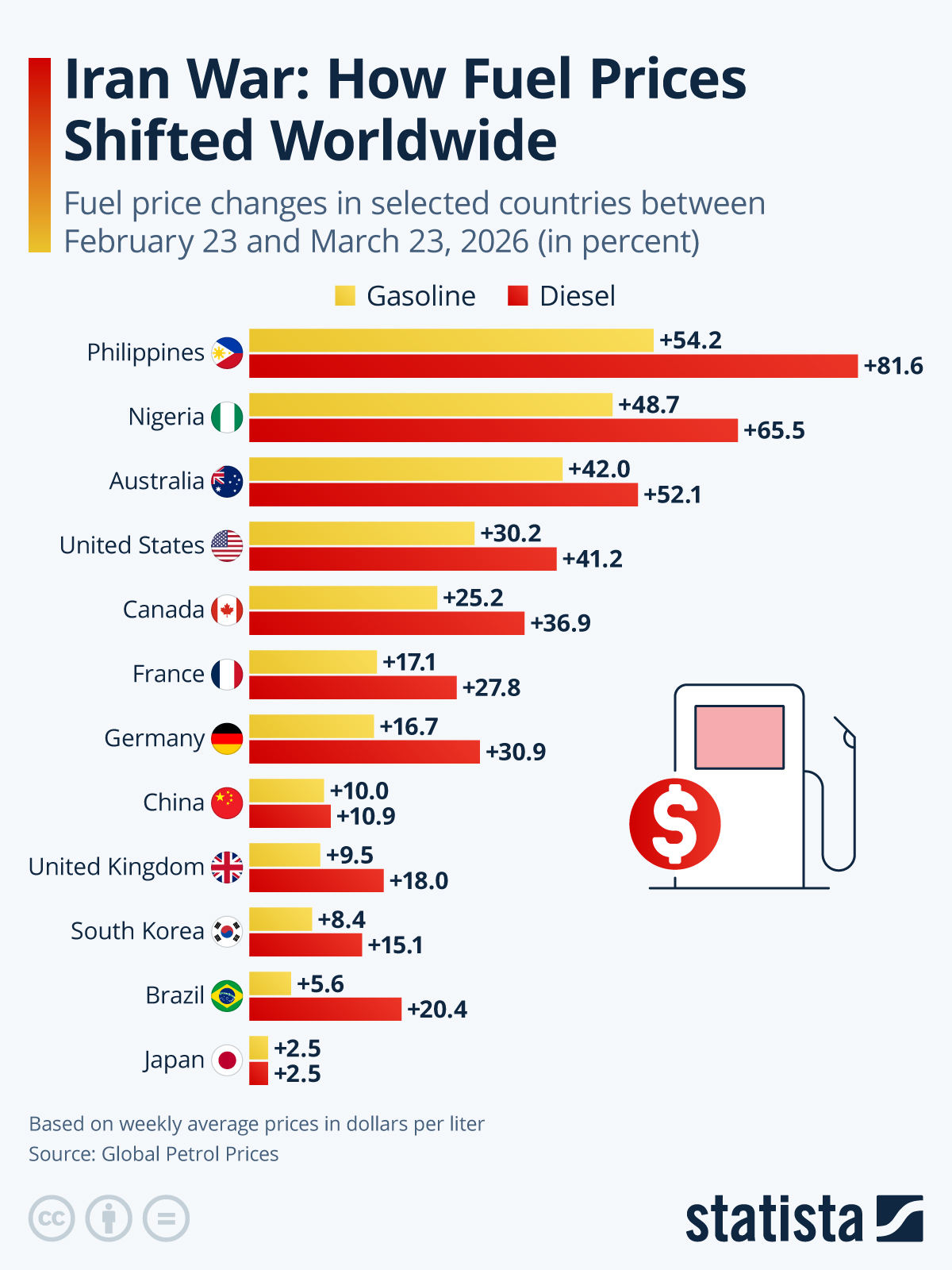 You will find more infographics at Statista
WHAT THIS MEANS FOR YOUR BALANCE SHEET
I want to be direct with the finance leaders reading this, because the geopolitical framing can obscure what is actually a set of very concrete balance sheet questions.
Three things are now true simultaneously that have not been true before.
1. Energy cost assumptions need stress-testing, as do inflation forecasts.
Brent crude around $100 in a sustained blockade scenario is not a tail risk anymore -- it is the base case until meaningful ship traffic resumes.
US Energy Secretary Chris Wright said prices will keep rising until that happens, and estimates it could be weeks away at minimum. Sustained $100-plus oil feeds into inflation expectations, delays rate cuts, and extends the period of elevated funding costs.
If your capital expenditure or operational cost base has material energy exposure, the assumptions that went into your last budget need revisiting now.
2. The NIM pressure was already building before this week.
The Yield War I described in the news section didn't start with the Hormuz crisis.
It started the moment the GENIUS Act was signed and stablecoin issuers began offering 3.5% on dollar-pegged tokens against a banking system paying fractions of a percent on deposits.
The Hormuz crisis accelerates that story in one specific way.
Elevated oil prices mean elevated inflation.
Elevated inflation means rates stay higher for longer.
And rates staying higher for longer means the yield gap between stablecoins and traditional deposits stays wide -- or widens further.
The rate-sensitive depositors in your book are doing that maths right now.
Standard Chartered's $500 billion deposit outflow projection was built on a normalising rate environment. A prolonged high-rate, high-inflation environment driven by an oil shock could bring that timeline forward.
3. Stablecoins are now inside the national security perimeter.
This is the most important structural shift of the week and the one most likely to be underweighted by finance leaders focused on the naval theatre.
The GENIUS Act enforcement rules didn't just regulate stablecoins.
They conscripted them.
Stablecoin issuers are now financial institutions under the Bank Secrecy Act, with OFAC obligations, freeze capabilities, and sanctions screening requirements baked into their technical infrastructure.
That has two implications running in opposite directions.
For illicit use -- the Iranian toll corridor, sanctions evasion, terrorist financing -- the grey area is closing fast. The financial blockade running alongside the naval one is not symbolic.
It has teeth.
But for legitimate institutional use - cross-border treasury flows, correspondent banking alternatives, trade settlement - the same regulatory clarity that closes the grey area also opens the door to serious adoption.
When stablecoin issuers operate under BSA obligations with independent audits and OFAC compliance programs, the objection that kept most institutional treasuries on the sidelines starts to lose its force.
The GENIUS Act is both a weapon and an invitation. Which one it is depends on which side of the transaction you're on.
THE VIEW FROM THE TREASURY DESK
I have spent 25 years watching monetary infrastructure change in ways that seemed theoretical until it wasn’t.
The money market fund disruption of the 1980s looked like a niche product story until it repriced the entire deposit funding model for a generation of banks through the 90s.
Nobody rang a bell at the top.
The correspondent banking de-risking wave of the 2010s looked like a compliance story until entire Pacific corridors lost their dollar access and finance ministers were calling their central banks at midnight.
This feels like the third one.
The Strait of Hormuz crisis will resolve.
It may take weeks. It may take months. The tankers will move again.
But the GENIUS Act enforcement rules will not be unwound.
The stablecoin corridor that Iran used -- and that the US just closed -- will not reopen in its old form.
And the $500 billion deposit migration question that the ABA and the White House are fighting about in Washington this week will not go away when the ceasefire holds.
The game has changed. The pipes are being rewired.
WOPR ran three million scenarios and found no winning move.
The difference in 2026 is that the game isn't over. It's just getting started.
And the finance leaders who understand the infrastructure -- not just the headlines -- will be the ones who see what's coming before it arrives.
-Thanks for reading.
Mark
P.S. If you would like to contact our team just reply to this email - we read every response.
If this issue made you think differently about stablecoins, forward it to a CFO, treasurer, or finance leader who should be reading it.
The conversation is just getting started.
